additional offer


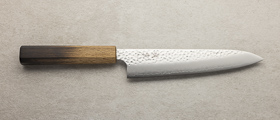
Tadafusa gyuto (chef`s) 210 mm
2219131203087
In stock
139,00€
Lowest price in the last 30 days: 139,00€.
30 in stock

Free shipping

30-day return policy

Orders placed by 2pm shipped the same day
Sanjo / Niigata / Japonska
Tadafusa is a respected Japanese forge based in the city of Sanjo in Niigata Prefecture, a region famous for centuries of metalworking tradition. Although officially established in 1948, its roots go deep into a more than 350-year heritage of Japanese forging. Tadafusa focuses on the handmade production of kitchen knives, where each product combines traditional Japanese techniques – such as hand tempering and sharpening – with a precise modern design philosophy. Their knives, made from high-performance steels like Aogami (Blue Paper Steel) and SLD steel, are renowned for exceptional sharpness, excellent durability, and a naturally balanced feel in the hand. Due to their functionality and affordability, Tadafusa knives are especially popular with culinary professionals who appreciate authentic Japanese quality and everyday reliability.
Gyuto (chef’s) knife – written in Japanese as 牛刀包丁 (ぎゅうとう) and pronounced “Gyūtō Bōchō.” Literally, “Gyu” means cow (as in “Wagyu”), and “To” means blade, so Gyuto could be translated as “cow sword.” It is the Japanese equivalent of the Western chef’s knife — a versatile tool used for preparing meat, vegetables, and fish. Blade length: typically 180–270+ mm. The knife closely resembles the Western chef’s knife, with the widest point near the heel where the edge is flattest. From there, the belly gently curves toward a pointed tip. The tip, designed for precise work, allows fine slicing, dicing, and chopping, while the slight curve between the middle and tip enables rocking motions. The wide profile makes it easy to transfer food from the board to a pan, and the flat heel section ensures smooth cutting on the board.
Shirogami #1, also known as White Steel, is a premium Japanese carbon steel and one of the finest choices for traditional Japanese knives. Its name, meaning “white paper,” comes from the simple white paper packaging used by Hitachi Metals. This steel is extremely pure, containing only carbon and iron with minimal impurities, allowing it to achieve exceptional sharpness and effortless sharpening. With a high carbon content, it can reach hardness levels up to 64 HRC, producing an incredibly fine edge that stays sharp for long periods. However, it is more brittle and prone to rust, requiring careful maintenance. Shirogami #1 is a favorite among experienced chefs who appreciate traditional sharpness and unmatched precision.
Blade shape: Gyuto
Steel: Shirogami (White 1)
Hardness: 63
Knife length: 350 mm
Blade length: 210 mm
Blade thickness: 1 mm, 2
Manufacturer: Tadafusa
Handle length: 135 mm
Blade geometry: Hollow grind
Blade construction: 3 layers
Manufacturer location: Sanjo / Niigata / Japan
Handle material: Oak
Handle: Japanese "WA" Handle
Weight: 176 g
Steel type: Traditional japanese steel
Usage: All-purpose
Finish: Kurouchi
Characteristics of steel
HARDNESS
Grinding (difficulty)
SHARPNESS
Sharpness stability
Maintenance
Related products

20,00€