

additional offer


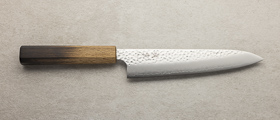
Shizu Miyako gyuto damascus 180 mm
2211652202437
In stock
140,00€
Lowest price in the last 30 days: 140,00€.
33 in stock

Free shipping

30-day return policy

Orders placed by 2pm shipped the same day
Seki City / Gifu / Japonska
Shizu Hamono is a Japanese forge with a long tradition originating from the city of Seki. The company was founded in 1980 and is based on a rich forging heritage that in this region dates back to the 12th century. They proudly emphasize that their top craftsmen combine rich history and modern culinary trends, designing and sharpening kitchen knives that are both aesthetically refined and useful for today’s needs. Each knife is subjected to strict and the latest quality standards – they are manufactured along with precise internal inspection instructions to ensure perfection in every product. Because they trust this system, they claim their products are top-class. Shizu Hamono is known for still hand-sharpening and polishing the cutting edges of their knives. This process enables sharpness and durability that often surpasses factory-automated alternatives. Their knives combine Japanese aesthetics and European usability. They use high-quality steels, including VG10 for the GEN series and AUS8 for the Yuri series. They also place special emphasis on visual effects, such as the kuro-uchi finish – a dark oxidation that adds character and an authentic Japanese note to the blade. Among the most recognizable lines of the company are the GEN, Yuri, and Miyako series. The GEN series is known for VG10 steel, black finish, and elegant appearance that combines traditional and modern. Yuri offers somewhat lighter knives with AUS8 steel, a thin profile, and a classic Japanese handle, making it an excellent choice for those looking for quality at an affordable price. Miyako stands out with a 33-layer Damascus pattern, AUS8 core, and a hybrid Pakkawood handle. The series combines Japanese aesthetics with everyday usability – the knives are durable, easy to maintain, and popular with both home cooks and professionals.
Gyuto (chef’s) knife – written in Japanese as 牛刀包丁 (ぎゅうとう) and pronounced “Gyūtō Bōchō.” Literally, “Gyu” means cow (as in “Wagyu”), and “To” means blade, so Gyuto could be translated as “cow sword.” It is the Japanese equivalent of the Western chef’s knife — a versatile tool used for preparing meat, vegetables, and fish. Blade length: typically 180–270+ mm. The knife closely resembles the Western chef’s knife, with the widest point near the heel where the edge is flattest. From there, the belly gently curves toward a pointed tip. The tip, designed for precise work, allows fine slicing, dicing, and chopping, while the slight curve between the middle and tip enables rocking motions. The wide profile makes it easy to transfer food from the board to a pan, and the flat heel section ensures smooth cutting on the board.
Blade shape: Gyuto
Steel: AUS8+SUS410
Hardness: 59-60
Knife length: 310 mm
Blade length: 180 mm
Blade thickness: 2 mm
Manufacturer: Shizu Hamono
Handle length: 130 mm
Blade geometry: Hollow grind
Blade construction: 33 layers
Manufacturer location: Seki City / Gifu / Japan
Handle material: Laminated wood
Handle: European "YO" Handle
Weight: 158 g
Steel type: Stainless steel
Usage: All-purpose
Finish: Damascus
Characteristics of steel
HARDNESS
Grinding (difficulty)
SHARPNESS
Sharpness stability
Maintenance
Related products


149,00€

269,00€


